




Research

California Tax Change Will Hurt Entrepreneurs and Job Creation

CA-Private-Sector-Annual-Net-Job-Creation.png

The removal of a state tax incentive for investment in startups is likely to make capital scarcer for California companies most poised for high growth—harming job creation and an already vulnerable state economy in the process. The change breaks with current federal policy and puts California’s entrepreneurs at a relative disadvantage to those in other states. We estimate that investments in California’s startups will decline by a conservative 2 percent each year from the tax change—translating to a drop of at least $85-$127 million annually based on 2011 data.

In December, the California Franchise Tax Board (FTB) announced changes to capital gains tax exclusions on Qualified Small Business (QSB) stock holdings. The change stemmed from an appellate court ruling that found minimum in-state asset and employment requirements during the holding period of the QSB stock unlawful under the U.S. Commerce Clause. Rather than remove the in-state asset and employment threshold requirements, the FTB instead chose throw the baby out with the bathwater and eliminate the capital gains tax exclusions altogether—effectively increasing state taxes on investments held in QSBs from 4.65 percent (under a 50 percent exclusion) to 9.3 percent (under zero exclusion).

The real attention grabber has been the FTB’s choice to make the change retroactive to 2008—with penalties and interest—despite the fact that investors were following what was then current law. While investors are up in arms over this, entrepreneurs may actually have the most to lose moving forward. 

Capital is the lifeblood of startups. This move by the FTB, which amounts to a tax hike for investors, will likely make capital scarcer for young businesses. Fewer startups means less job growth; for the last 30 years, young companies have provided all of the net new job creation in California and the United States as a whole.

Matching an existing framework with data on California, it’s possible to generate a conservative, back-of-the envelope, estimate of investment startups in the state might lose. This drop would likely have a negative impact on the California economy—not only have startups been the engine of new job creation in the state, but the QSB capital gains tax exclusions were targeted especially at businesses with the highest growth potential.

Estimating Investment Impact of Tax Change

A 2012 Kauffman Foundation report provides the framework for estimating the impact of tax changes on early-stage investments in startups. The report yields a conservative estimate of the additional investment in startups that would occur if 100 percent of the capital gains held at least five years were excludable from federal taxation, compared with an earlier exclusion of 50 percent. In other words, the report tells us how much investments of this nature might increase when taxes are reduced.

We employ that same framework here but move in the opposite direction, answering the question: how much would investments in startups decline from what amounts to a tax increase? Then we apply this estimate to data on investments in California startups.

Let’s unpack the potential investment response to the tax increase by using a hypothetical example. The Kauffman report states that a reasonable assumption for a real pre-tax return on privately held investments in startups in the current interest rate environment is 10 percent. At least one prominent angel investor group agrees, and so do we. 

Under this assumption, an investment of $100 would be worth $161 after five years on a pre-tax basis. If the tax rate were 4.65 percent, as it was under the previous 50 percent exclusion in California, that same investment would be worth $158, for an average annual return of 9.6 percent. Under a 9.3 percent tax rate regime (zero exclusion), that same investment would be worth $155—returning 9.2 percent per year on average. Capital gains in QSBs are currently fully excludable from federal income taxes and were in 2011 as well—the base year used in our analysis.

A change in the effective tax from 4.65 to 9.3 percent results in a 4 percent drop in the average annual return on the investment (from 9.6 percent to 9.2 percent). Based on previous research on the topic, and conversations with experts in the field, the Kauffman report concluded that the responsiveness (the “elasticity”) of such a change in the rate of return on aggregate investments is a conservative 0.5—or half the change in return. In other words, the 4 percent decline in a typical return would result in a 2 percent drop in investment overall. Two percent may not seem like a big decrease, but when applied to a large base like in California, it can be.

To see how big of a dent 2 percent could make, the baseline estimate of equity invested in California startups is tabulated from three sources of “seed funding”:

Seed-Stage Investments in California Startups (2011)

Source of funding $ (in Billions)
Venture capital $0.5
Angel investors $2.8-$4.4
Entrepreneurs' equity     $0.8-$1.2
Total $4.1-$6.1
 Sources: PricewaterhouseCoopers MoneyTree, Center for Venture Research, Silicon Valley Bank, Kauffman Foundation; Engine calculations

In total, an estimated $4.1-6.1 billion was invested in California seed-stage startups in 2011. It is reasonable to assume that essentially all of these seed funds were invested in traditional C corporations—the type of company that is most suitable for startups and is eligible for the QSB tax deduction. For scope, that amounts to between 32 and 47 percent of such investments in the entire United States.

With a baseline of $4.1-6.1 billion, and a 2 percent reduction in investments from the tax change, we’re left with a decline of $85-127 million in investment in startups each year in California. Now, $85-127 million per year may not sound like a whole lot of money relative to total investments in startups broadly, but over ten years it totals between $853 million and $1.27 billion. Moreover, whether we are talking about an annual or decade-long framework, considering that seed-stage companies may receive as little as $15,000 in funding (though a typical amount is in the hundreds of thousands), we’re talking about a lot of companies that may be adversely affected.

What’s more, this is almost certainly an underestimate of the value of investments in California startups and the effect the tax change would have. To begin, the Kauffman report reiterates that its framework is likely to yield conservative estimates. Most notably, it states that the elasticity estimate of 0.5 is likely conservative—meaning that for each 1 percent decline in a typical rate of return, overall investments would fall by more than 0.5 percent.

Secondly, since QSB status in California applies to companies with up to $50 million in assets, many businesses beyond the “seed/startup stage” would qualify. As a result, we are surely undercounting the pool of investment in the state that would be affected by the tax change.

Third, the 2011 statutory state tax rate applied here (9.3 percent) is lower than the marginal rate charged to those with incomes above $1M (10.3 percent), which would apply to a non-trivial number of investors in startups. These investors would be adversely affected even more than our rough estimates indicate.

Finally, the Kauffman framework was previously applied to federal tax—which would be applied uniformly across states. Holding federal tax rates and all other factors constant, other states would have an advantage against California. According to the Angel Capital Association, twenty states have tax incentives for angel investors and California isn’t one of them. For example, states like Wisconsin are actively partnering with investors to increase investments in startups.

In addition to all of this, Proposition 30, which was adopted by California voters in November, raises state income taxes to varying degrees on individuals who earn more than $250,000 per year. Though this is outside the scope of our analysis—both because the year studied pre-dates that particular tax hike and because arguing the merits of state tax policy broadly goes beyond what we’d like to accomplish here—it will further compound the issue, potentially leading to even more declines in investments in California startups.

Economic Impact

Though data are not readily available to directly tie investments in QSB-type businesses specifically to the economic impact in California, data from the Census Bureau can illustrate the important role that new businesses play in job creation in the state.

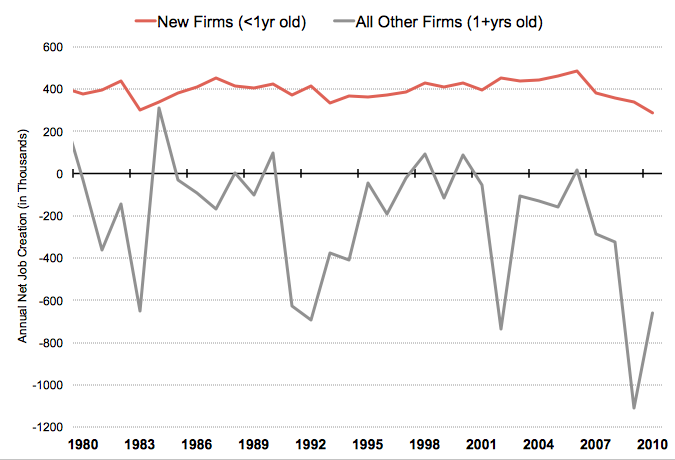
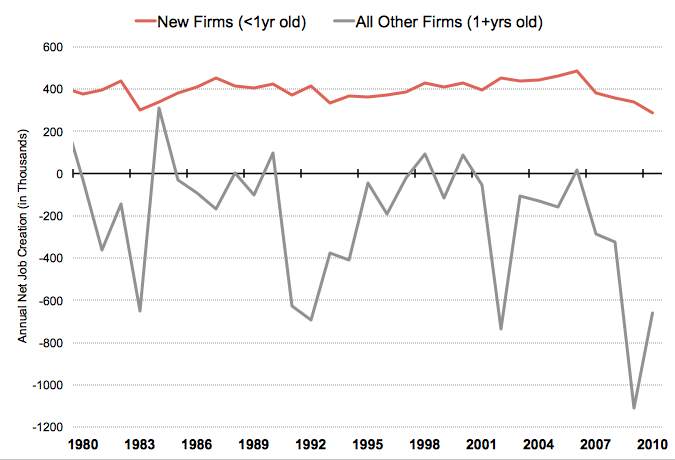
California Private-Sector Annual Net Job Creation by Firm Age (1980-2010)
CA Private Sector Annual Net Job Creation 

Source: U.S. Census Bureau, Business Dynamics Statistics

Between 1980 and 2010, businesses in their first year added an average of 398,193 new jobs each year. Companies aged one year or more, as a group, subtracted an average of 192,501 each year during that same period. This occurred because the forces of job destruction (through business contractions and closures) were stronger than the forces of job creation (through firm births and expansions) for businesses older than a year old as a group. In other words, outside of startups, net job creation in California was negative during the past three decades.

In addition to the job creation dynamics of new firms, among existing businesses it is young firms (those less than five years old) that have the biggest effect on job creation. Taken together with the chart above, we can say that new and young firms are responsible for all net new job creation during the past few decades.

Conclusion

The FTB’s tax change is likely to reduce investments in California’s startups by a conservative 2 percent each year, translating to $85-$127 million fewer investments annually based on 2011 data. This can’t be a good thing for the economy or job creation in the state. At a time when the state unemployment rate hovers around 10 percent, California can hardly afford to place any of its companies at a competitive disadvantage—especially not those poised for high growth. On top of that, a recent survey of small businesses sponsored by the Kauffman Foundation found California to be among the least friendly for entrepreneurs

Though it is understandable that state authorities are searching for ways to improve the fiscal situation of California, this isn’t a good way to go about it. The entire point of providing a tax incentive for these investments is to make them more attractive to investors, relative to others, precisely because seed-stage investments are very risky and because startups have important spillovers to the economy—namely that they fuel economic growth and job creation.

Moving forward, not only should state policymakers reinstate the QSB capital gains exclusion, they should extend it—making capital gains on these investments fully excludable. There is already precedent for this at the federal level too: in 2010 Congress temporarily made these investments fully excludable and recently extended this policy through 2013. If Washington can see the wisdom in doing this, why can’t Sacramento?

Ian Hathaway is the research director at Engine

Tech America: The Spaces Where Entrepreneurs Start Up

If you’ve read Technology Works, the report commissioned by Engine Advocacy and published last Thursday, 6th December, you know the importance of startups and entrepreneurship in getting America’s economy back on track. Despite America’s status as a great place for businesses, launching a startup is a difficult task. Incubators and accelerators are organizations that make that process a bit easier, and are a crucial ingredient in the country’s future economic prosperity.

So where are these entrepreneurial instigators? No doubt you’ve heard about Y Combinator, Tech Stars, and other well-known programs. And we all know about the great things happening in Silicon Valley, Silicon Alley, and the hotspots of Austin, Texas or Boston, Massachusetts.
But you may be surprised to learn that incubators and accelerators, like the startups they support and cultivate, are all over the country - from Groundwork Labs in Durham, North Carolina and the Manoa Innovation Center in Honolulu, Hawaii, to UpTech, an accelerator located in Newport, Kentucky.

Some incubators are founded by technologists, like 8ninths in Seattle, Washington, while some are launched by universities, such as Ohio University’s Innovation Engine Accelerator. Still others are formed by major companies, like Microsoft, PayPal, and Qualcomm, who want to stimulate the next generation of technology leaders.

Back in September, with the help of Engine, the Ammori Group put together a map based on startup incubators and accelerators across the country. Our goal was to develop a way for entrepreneurs, incubator leaders, and policymakers - everyone, really - to see where the incubators are, to learn about what they’re doing, and to get involved.

If your incubator or accelerator isn’t on the map, let us know by submitting your information. If it is on the map, feel free to update your information and tell us about your experiences. And please, share this with your colleagues, friends, and anyone interested in seeing where innovation is happening in America today.

Luke Pelican is an associate at The Ammori Group

Technology Works for Startups and Our Economy

TechWorksMap.png

We are proud to announce the launch of Technology Works today, a study demonstrating the pervasive and important growth of the tech workforce across the United States. Engine is committed to tracking the close connection between innovation and entrepreneurship. This new research, which we commissioned from the Bay Area Council Economic Institute, demonstrates the connection between high tech employment and overall economic prosperity.

Today’s study is an expansion on the data visualization we launched during the party nominating conventions that illustrates the geographically diverse nature of technology hubs in the U.S.

More than ever, startups harness technology to achieve their goals. This means hiring more people with skills in the science, technology, engineering, and mathematics (STEM) fields, the definitive factor in the Bureau of Labor Statistics’ defintion of high tech industries. Tech-focused startups tend to start small and grow rapidly, becoming the drivers of overall employment.

It’s easy to highlight startup success stories: Google, Facebook, Pandora, Twitter, and Yelp are just a few of the relatively young, tech-based companies that employ thousands of workers. As we better understand the multiplicative effects of hiring at these companies -- and the startups that will follow in their footsteps -- the case for supporting innovative entrepreneurs becomes apparent.

Communities experience significant benefits from high tech employment. We are able to estimate that the creation of one high tech job accounts for the creation of 4.3 other jobs in a local economy. How does that work? Technology workers tend to earn more than their peers in other industries, which they put back into the local economy by consuming goods and services. Tech companies companies also rely on local services and vendors, further driving local benefits.

So while many Americans may never work for a company like Google or a technology-focused startup, they still benefit from the impact these jobs have in communities around the country. About two-thirds of the U.S. labor force works in local services, ranging from healthcare to legal services to restaurants. As Enrico Moretti, Professor of Economics at the University of California, Berkeley, said about the study, “the dynamism of the US high tech companies matters not just to scientists, software engineers, and stockholders, but to the community at large.”

Our research with BACEI makes it clear that the economy increasingly depends on innovation. Explosive job growth isn’t likely to come from the established internet giants. It will bloom from driven entrepreneurs making the most of the technologies at their fingertips. Engine is committed to continuing analyses of startups’ impact on the economy and we’re planning further compelling research in the near future.

Put Your Mark on Our Innovation Map

Screen Shot 2012 09 26 At 6.01.01 PmA few weeks back, we posted the first version of a simple tool to connect startups to incubators and accelerators in their communities. Created in association with our friends Luke Pelican and Marvin Ammori, we’re aiming to build out the map further. We’re looking to you -- investors, mentors, and entrepreneurs -- to tell us where these innovation hubs are to better connect with entrepreneurs.

Startups are critical to economic growth and job creation. Connecting entrepreneurs to resources that will help grow their businesses will be critical to keep this trend going. By submitting information about your group, startups can more easily find the spaces that will help them thrive.

How does it work? Go fill out this survey and we’ll populate your information on our map (we’re a bit obsessed with maps lately). Before we do so, we’ll send a confirmation email to make sure you’re cool with being included. Then sit back and watch as your incubator or accelerator pops up on our map.

Simple, right? As adoption grows, we hope to build out and design this map into a more robust tool, but first we need the data from you to make it possible. So drop us a line and we’ll get back to you straight away. The country can’t wait for more startups to take off and you may be the group that mentors the next big startup success story.

Mapping Innovation and Entrepreneurship

Screen Shot 2012 09 26 At 6.01.01 PmStartups are flourishing across the country as we can see from the interactive map Engine released last month. What you may not know is that a network of incubators, accelerators, and other resources are available to entrepreneurs in these communities. Along with my colleague Marvin Ammori, we undertook a research project to catalog some of the important innovation hubs. With the help of our friends at Engine, we now have a tool to map these hubs for the benefit of entrepreneurs, job seekers, and policy makers. We welcome your help in continuing to build out this map for startups around the country.     

Startups are important: they drive economic growth and technological innovation, representing the best of entrepreneurialism and perseverance. However, finding assistance when launching a startup and building a business can be very difficult. Fortunately, there are organizations that help entrepreneurs turn a kernel of an idea into a thriving business: incubators and accelerators. These innovation spaces are a crucial ingredient for entrepreneurial success.

Generally speaking, incubators provide entrepreneurs with a place to set up shop, business resources, seed funding, networking opportunities, and other tools to get their companies started. Accelerators are similar in that they provide resources to young companies, but they also work with startups that are more established and help them to take their business to the next level. Together, these organizations play a critical role in the innovation ecosystem.

With Engine, we’ve created a map of incubators and accelerators that are helping startups throughout the country. Click on a pin to learn more about an individual innovation space. We show organizations that work with internet-focused companies -- app developers, software designers, and other related organizations -- but they may also host many other types of businesses.

The maps shows the innovation spaces that exist from coast-to-coast, in all 50 states. If you’re a startup looking for help launching or growing your technology company, check out the incubators and accelerators in your region. If you’re an incubator or accelerator but don’t see yourself on the map, fill in your information so we can add you.

Innovation Spaces Map

Survey  

Luke Pelican is an associate at The Ammori Group

Innovative U.S. Jobs, Startups Not Only a “Tech Center” Phenomenon

Screen Shot 2012 08 28 At 9.05.37 Pm

The tech sector may be driving the economy where you least expect. Today, in collaboration with the Bay Area Council Economic Institute, or BACEI, Engine launches its first major research project, demonstrating the importance of technology and entrepreneurship across the American economy. We invite you to explore the data and see where innovation is happening

Engine is San Francisco-based and we hear from people in business and government alike that startups and technology are centered in Silicon Valley, where a small network of innovators, investors, and entrepreneurs build the “new economy.” But in Engine’s effort to connect policymakers to entrepreneurs, we have worked with startups located across the country ranging from Kansas to Georgia to Michigan.

Our work with BACEI aims to tell the whole story. Using data from the Bureau of Labor Statistics and the National Establishment Time Series Database, BACEI calculations show that tech jobs and startups aren’t isolated. In fact, as BACEI economist Ian Hathaway told us last week, growth “is not only a ‘tech center’ phenomenon.” Communities including Dayton, Ohio and Troy, Michigan, and Columbia, South Carolina have experienced growth in technology employment exceeding 10 percent in 2011.

What BACEI observed:

  • Since the dot-com bust, jobs in the high-tech sector have performed better than for the private sector as a whole. 
  • A minimum of 61% of counties had at least some high-tech jobs in 2011 -- data limitations prevent a truer and larger estimate because data are suppressed in sparsely populated counties to protect the identity of individual companies. Estimates for many counties are not available.
  • Metro areas with the fastest growing high-tech jobs are geographically and economically diverse.
  • In 2009, more than 72% of counties had at least one new business establishment in the high-tech sector.
  • High-tech startups have held relatively steady during the economic downturn, even while new business establishments across the entire private sector have declined.

Let’s unpack this a little bit. Based on Department of Labor definitions, technology industries are those that include a very high share of technical disciplines -- those in science, technology, engineering, and mathematics fields (STEM). If you’ve been following Engine, you’ll know STEM employees play a critical role in startups and technology and that the need for STEM professionals has led to calls for new legislation to bolster startups.

Second, our data visualization tracks jobs in the private sector. This means we’re looking at all the jobs at companies in technology industries, not just workers with these professional skills. These industries include computer hardware, software, systems design, and information; high-technology communications and electronics equipment; internet publishing and web search portals; data hosting and processing services; pharmaceutical and medical manufacturing; aerospace manufacturing; architecture and engineering services; and research and development services. We aim to show that technology doesn’t just create jobs for engineers and computer scientists, but managers, designers, salespeople, and executives as well.

Finally, the startup data we track reflects new business establishments -- first-year startups -- in the same technology industries. This includes businesses across the board, including sole proprietorships that are not captured by Labor Department or Census Bureau data. It’s a broad net and captures a comprehensive picture of tech startup growth.

Our research aims to think critically about how technology, the internet, and entrepreneurship shape our economy. The first step is to dispel a few misconceptions about the location of tech jobs. Going forward, the analysis will provide insight into labor trends and their impact on public policy.

We want consumers, entrepreneurs, and policymakers to dive into the data -- looking at their own backyard or at the national level -- to gain a better understanding of how technology influences jobs. We think you might be surprised.