Section 230 of the Communications Decency Act has been called the most important law impacting the Internet and it continues to serve as the bedrock principle behind user-generated content. Startups rely on the intermediary liability protections found in Section 230 to innovate and create new ways for people to communicate. It guarantees that a website which gives users a forum to express themselves freely will not face ruinous legal liability if someone says something illegal. As policymakers consider how platforms protect users, they also must keep in mind how our increasingly digital and connected world allows us to share stories, creations, and innovations.
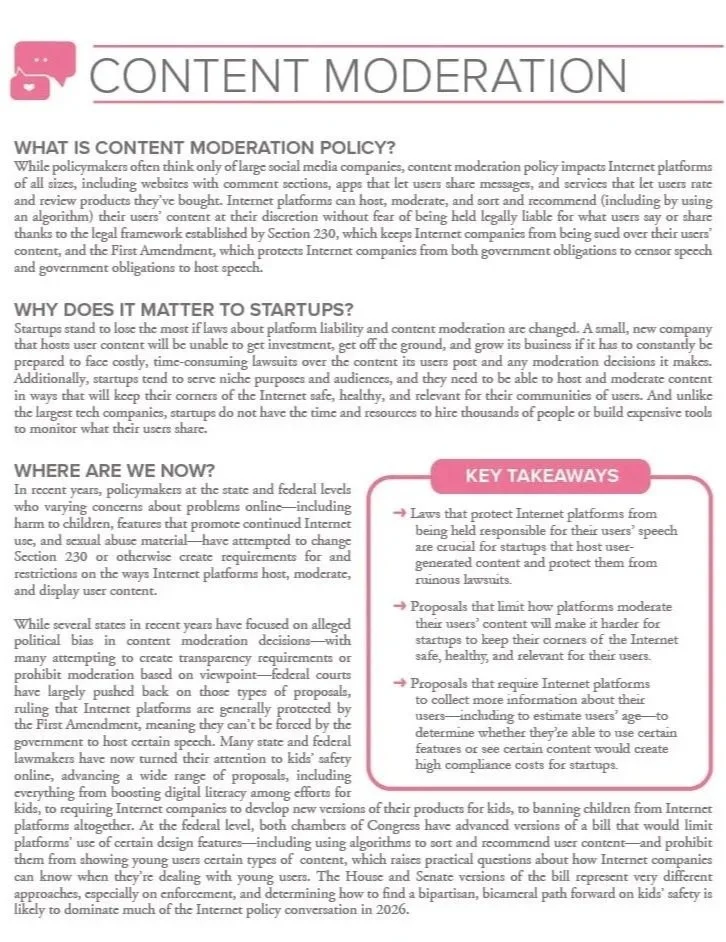
Content Moderation Primer for Startups
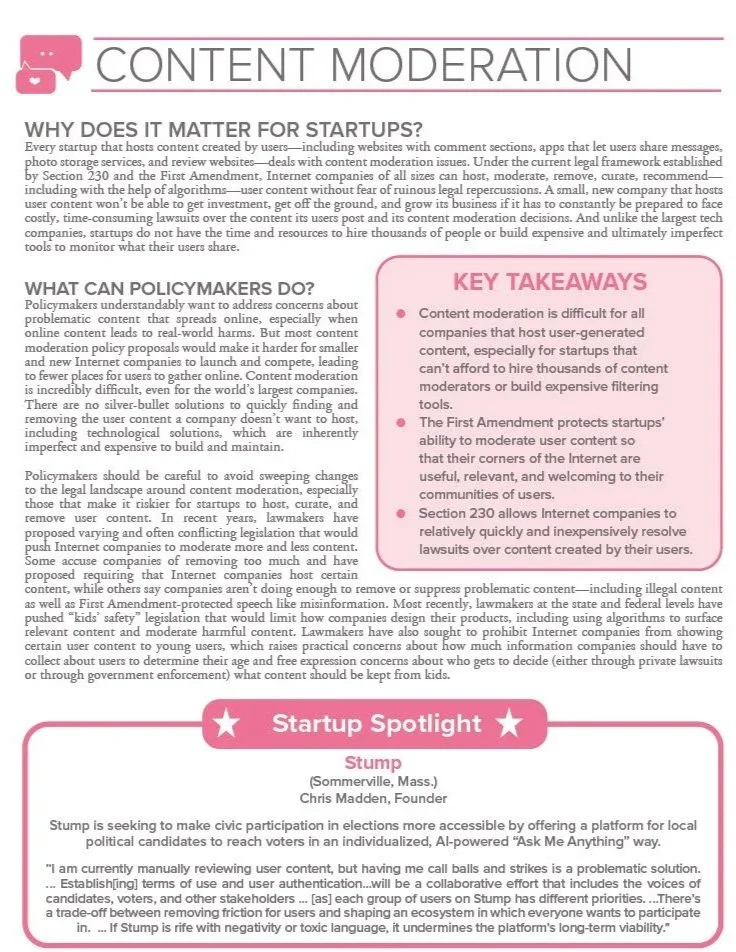
Content Moderation Primer for PolicymakerS
To help policymakers better understand what these issues mean for startups and their users, we’re releasing an updated version of the report, one-pager, and video explainers of the impacts of age verification and the policy proposals that prompt it.
How determining user age impacts startups
Debates about the intermediary liability framework provided by Section 230 have animated policy conversations as lawmakers grapple with harmful online content, including around election integrity, health information, and children’s safety. But those debates are almost exclusively focused on the largest Internet companies. Section 230, however, applies to all services of all sizes that host all types of user-generated content, including startups.
This week, a key House committee will consider a trove of online safety proposals, marking movement on one of the many intractable tech policy issues Congress perennially debates but rarely advances to the president’s desk. The proposed legislation comes with potential for a big impact on how startups design customer experiences, deliver their services, and interact with their users—regardless of those users’ ages.
30 years of Section 230 supporting user expression online, despite continued scrutiny
Today, Engine published the 2026 Startup Policy Agenda, highlighting the policy issues coming up this year that will impact startups.
Engine filed an amicus brief to the Supreme Court in Cox Communications, Inc. v. Sony Music Entertainment, arguing that Internet service providers and other intermediaries should not be held liable for users' alleged copyright infringment.
Engine filed comments with the FTC in response to the agency's request for public comment regarding "censorship" on "technology platforms.”
Engine released the 2025 Startup Policy Agenda showcasing how smart, thoughtful policy facilitates and encourages startup activity, leading to more innovation and more economic and job growth. The Agenda gives those working on policy an overview of the issues that are currently impacting—and the debates that stand to impact—startups.
Engine released the 2025 Startup Policy Playbook to give members of the startup ecosystem—founders, employees, investors, and support organizations—an overview of the policy conversations happening this year and how they can get involved in amplifying the startup voice. There’s lots to do, and lots to do better, and this playbook highlights why shaping innovation-friendly policies matters to startups.
Congressional Startup Day underscores importance of startups in policymaking
To help policymakers better understand what these issues mean for startups and their users, we’re releasing an updated version of the report, one-pager, and video explainers of the impacts of age verification and the policy proposals that prompt it.
How determining user age impacts startups
As summer kicks into gear, state legislatures are closing up shop, but not before introducing and passing legislation impacting startups. In the absence of federal action on many technology policy issues occupying the public imagination, state legislatures have acted to create their own rules, which can vary slightly, significantly—or outright conflict with—each other.
The Big Story: Supreme Court strikes down Biden student loan relief plan. The Supreme Court this week struck down President Biden’s student loan relief plan that would have canceled up to $20,000 in student debt for qualified borrowers. The decision, while not unexpected, is a blow to the millions of Americans riddled with student debt, and individuals whose debt acts as a barrier to pursuing entrepreneurship.
The Big Story: House advances tax package with pro-startup provisions. A House committee advanced multiple tax bills this week that include several startup priorities. Legislation passed by Republicans on the House Ways and Means Committee includes two bills—the Small Business Jobs Act and the Build It in America Act—that would fix R&D expensing, create startup investment incentives, and fix reporting threshold. While the entire package faces uncertainty in the Democrat-controlled Senate, several provisions—including startup priorities like R&D expensing— have bipartisan support.
The Big Story: Startups call on Congress to fix R&D expensing. Lawmakers in both chambers of Congress took steps this week toward addressing a critical tax issue impacting startups’ bottom lines: a recently enacted change to how startups expense research, development, and experimentation costs. House and Senate lawmakers held two hearings this week exploring how the tax code, including incentives around R&D impact small businesses and startups.
The Big Story: House passes capital formation bills. The House passed several bills this week to improve capital access for startups, including by providing educational resources on capital raising options for underrepresented small businesses and another to broaden the pool of potential startup investors.
The Big Story: EU data ruling further imperils transatlantic data flows. A decision this week by a major EU privacy regulator is adding to uncertainty over companies’—especially startups’—already tenuous ability to store and process user data from EU users in the U.S.
The Big Story: Congress digs into recent bank failures. This week, committees in both chambers held hearings to examine recent bank failures, including the collapse of Silicon Valley Bank (SVB)—a key financial institution in the startup ecosystem. The collapse of SVB in particular devastated many across the innovation ecosystem, sending companies scrambling to withdraw funds and make payroll, uncertain if their full balances would be secured.
The Big Story: The difficulties of content moderation and the chance to try it yourself. Critics of the Internet industry, including policymakers, frequently complain about content moderation decisions and propose legislative changes that would make it harder for Internet companies to host, remove, demote, amplify, and curate user content. To help inform those conversations, Engine worked with Copia and Leveraged Play to develop a new video game this week—Moderator Mayhem—with the goal of highlighting the difficulties and the inherent tradeoffs Internet companies, especially startups, face while navigating moderating their users’ content.
The Big Story: “Children’s safety” push for more data collection, content scanning. Lawmakers reintroduced and advanced legislation that would push Internet companies of all types and sizes to collect more data from their users and scan public and private user content in the name of childrens’ safety. The bills—including the Kids Online Safety Act, the Children and Teens’ Online Privacy Protection Act, which were reintroduced this week, and the Eliminating Abusive and Rampant Neglect of Interactive Technologies (EARN IT) Act, which advanced out of the Senate Judiciary Committee this week—would remake the regulatory framework that enables startups to grow and succeed.
The Big Story: Over 65 startups call for uniform federal privacy law. This week, startups are calling on Congress to pass a federal privacy law that takes the startup ecosystem into account. A coalition of startups and support organizations across 26 states sent a letter to Congress urging lawmakers to pass a law that creates uniformity, promotes clarity, limits bad faith litigation, accounts for the resources of startups, and recognizes the interconnectedness of the startup ecosystem. The letter comes as states continue to enact their own unique data privacy laws, and as a Congressional committee explored the problems posed by a sectoral federal privacy landscape in a hearing this week.
The Big Story: Non-compete ban would boost the startup ecosystem. Policymakers received thousands of comments this week as a key agency considers a change that would make it easier for people to leave their jobs, including to found and join early stage startups. In conjunction with the Juelsgaard Intellectual Property and Innovation Clinic, Engine submitted comments this week to the Federal Trade Commission urging the agency to move forward with a proposed rule change that would ban most non-compete agreements, which are post-employment contracts that bar workers from taking up jobs with competitors for a prescribed period of time.
The Big Story: Policymakers set their sights on artificial intelligence. This week saw a frenzy of activity from policymakers around the globe looking to regulate artificial intelligence technologies, which startups are increasingly leveraging in their products. In the U.S., federal agencies recently kicked off processes to examine AI and intellectual property as well as AI accountability, while Congress is exploring legislation. Abroad, policymakers have used existing regulations to ban certain AI tools and are looking to adapt their proposed AI rules.
The Big Story: States continue adding to tech regulatory landscape risking additional burdens for startups. State legislative sessions are in high gear this spring, advancing tech legislation and threatening to grow a patchwork of varying rules startups must navigate as they grow. This week, for example, the Washington Senate passed a bill governing health information and other personal data. Their effort joins several other states putting forward proposals aimed at privacy and data security, online safety, and content moderation—that each will have noticeable ripple effects for startups.
The Big Story: R&D tax credit changes create tax bill for startups. Startups and other companies are facing higher taxes this year after a provision from a 2017 tax law went into effect recently. The law, the Tax Cuts and Jobs Act (TCJA), triggers a change to how the research and development (R&D) tax credit operates. Unless policymakers step in, startups and small businesses will have to weather the blow to their cash flow and may consider limiting future R&D costs. This could ultimately result in an overall reduction in innovation in the U.S., slowed economic growth, and decreased ability for our innovation ecosystem to compete with other countries.
The Big Story: New research shows state privacy patchwork costs startups hundreds of thousands. Startups spend hundreds of thousands of their limited resources on privacy compliance, much of which goes to duplicative activities that don't further users' privacy, according to a report Engine is releasing today. The report, Privacy Patchwork Problem, chronicles the steps startups are taking to protect the data of their users and enumerates the costs, burdens, and barriers startups encounter—which reach into the hundreds of thousands of dollars. It underscores the need to give for a federal privacy framework that creates uniformity, promotes clarity, and accounts for the resources of startups, while creating consistent rights for their users located in every state across the country.