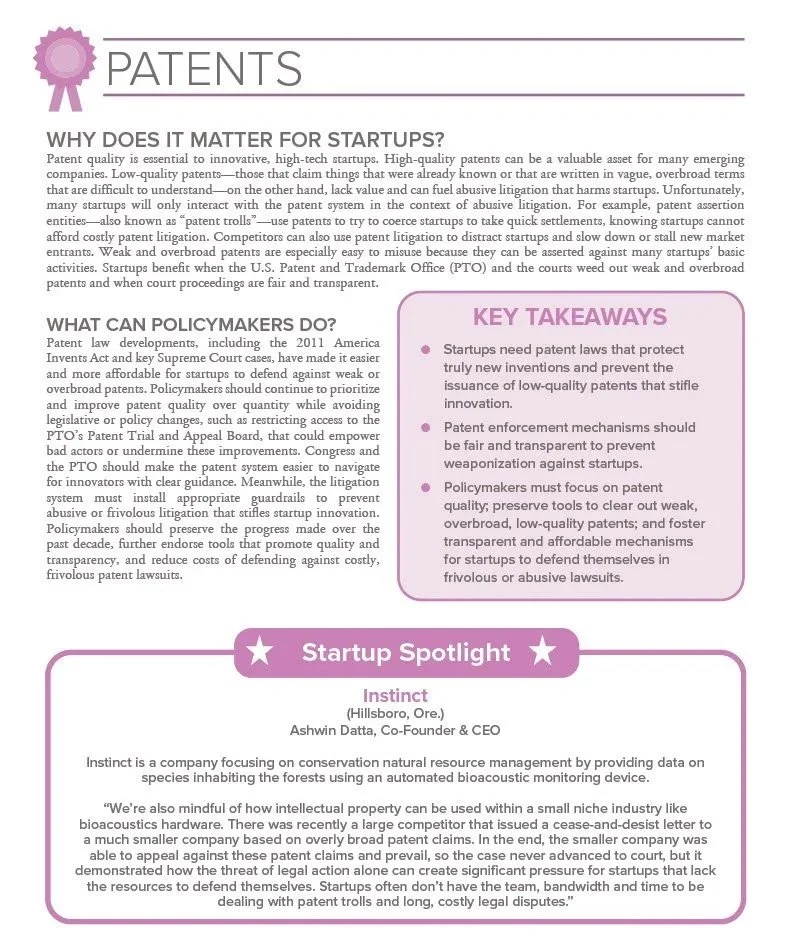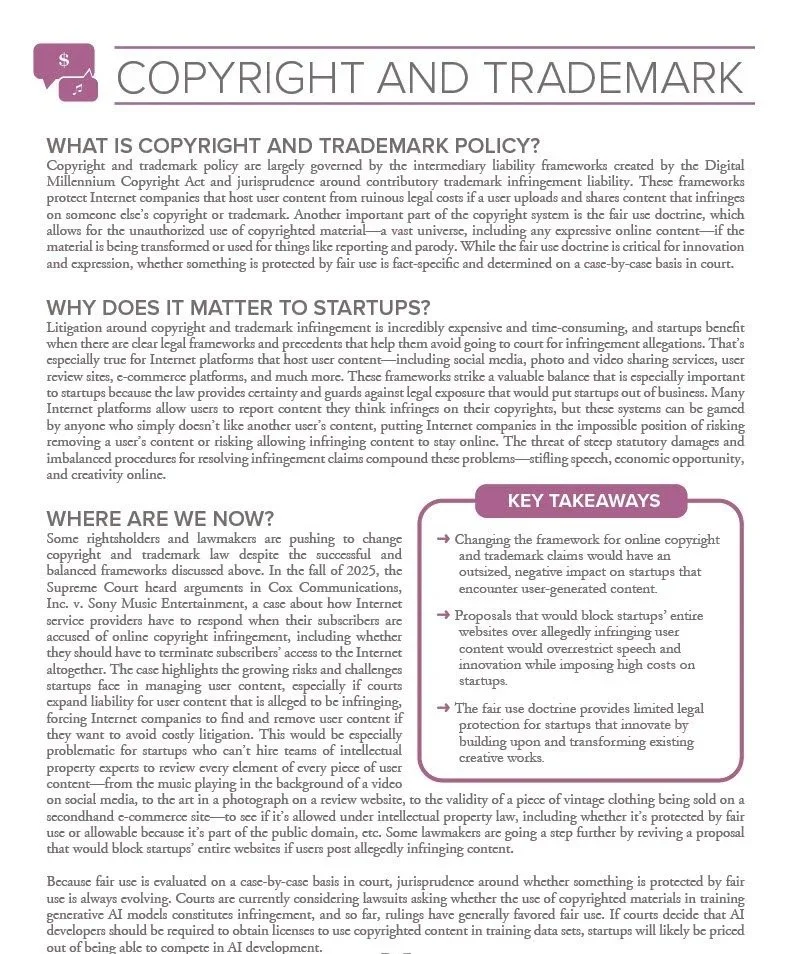
Patents were developed to encourage openness in the innovation space and to protect inventors. Unfortunately, startups frequently face abusive patent litigation by “patent trolls” — companies that take advantage of a broken software patent system and operate by collecting fees on software patent licenses, instead of making products and contributing to technological innovation. Meanwhile, new distribution technologies are making it easier for anyone to reach a broad audience, which is why we need balanced copyright laws that allow these new technologies and their creators to succeed.
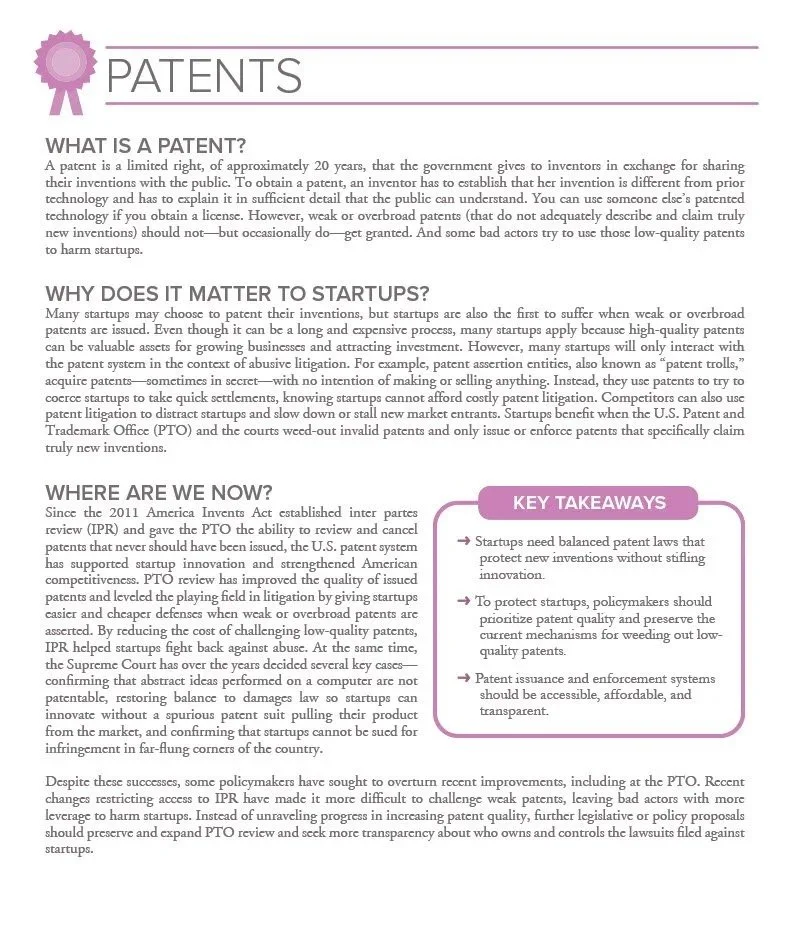
Copyright & Trademark Primer for Startups
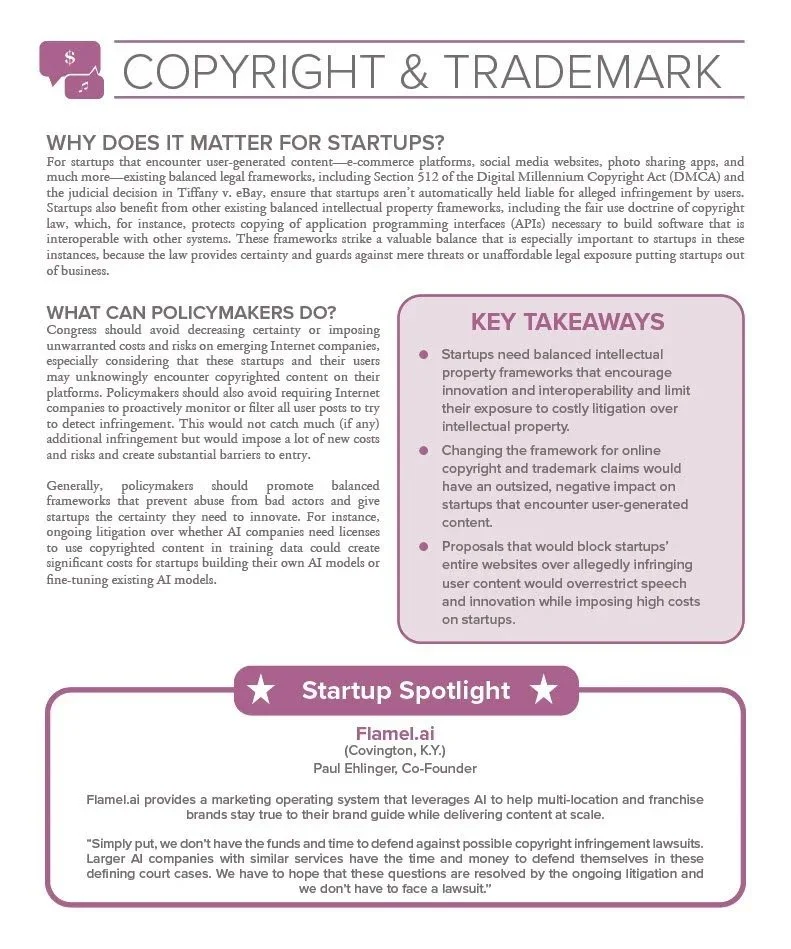
Copyright & Trademark Primer for Policymakers
Startups & the U.S. Patent System: Prioritizing Quality and Balance to Promote Innovation
The Trump administration is reportedly exploring a new framework for patent fees and valuation.
A key tool that promotes innovation by weeding out weak patents that can be weaponized against startups is being scaled back by federal policymakers.
The recent legislative and agency efforts directed at regulating digital replicas of individuals’ name, image, and likeness (NIL) have the potential to harm startups’ access to the artificial intelligence (AI) ecosystem and chill innovation.
Congressional Startup Day underscores importance of startups in policymaking
In a series of State Policy Updates, we are exploring how state initiatives are impacting the innovation happening in startup ecosystems across the country.
Senate advances Internet regulation rife with unintended consequences
Startups call for better access to capital for entrepreneurs of color
Startups to face hiring challenges following independent contractor rule
The Big Story: Over 65 startups call for uniform federal privacy law. This week, startups are calling on Congress to pass a federal privacy law that takes the startup ecosystem into account. A coalition of startups and support organizations across 26 states sent a letter to Congress urging lawmakers to pass a law that creates uniformity, promotes clarity, limits bad faith litigation, accounts for the resources of startups, and recognizes the interconnectedness of the startup ecosystem. The letter comes as states continue to enact their own unique data privacy laws, and as a Congressional committee explored the problems posed by a sectoral federal privacy landscape in a hearing this week.
The Big Story: Section 230, privacy, encryption in crosshairs at kids safety hearing. The Senate Judiciary Committee held a hearing Tuesday on protecting children’s safety online, where lawmakers suggested changes to several issues important to startups, like Section 230, data privacy, and encryption. The wide-ranging proposals appear conceived with the largest tech companies in mind, but they would affect all Internet companies, especially startups. The hearing comes amid efforts from policymakers at all levels of government aimed at safeguarding young Internet users that could carry unintended negative consequences for startups without necessarily protecting children.
Bad actors are constantly looking to trick unsuspecting startups into unnecessarily giving up their already-limited resources. One scam gaining in popularity is to impersonate government officials and ask startups for payment to “renew” their existing trademarks, and it demonstrates how intellectual property systems can be weaponized against startups.
You might not realize it, but whether you’re a startup founder, a digital entrepreneur, or a casual technology and Internet user—what the U.S. Patent and Trademark Office (USPTO) does impacts you and the agency needs to be listening to you. That’s why Engine filed comments this week on USPTO’s draft strategic plan, suggesting ways the agency could improve its plans to support all U.S. innovators, creators, and entrepreneurs.
The Big Story: Engine releases report on the role of acquisitions in the startup ecosystem. Engine, in partnership with Startup Genome, released a new report this week examining the role exits play in the startup ecosystem, highlighting the importance of exits via acquisition, and emphasizing the experience of founders that have had their companies acquired. The report—“Exits, Investment, and the Startup Experience: the role of acquisitions in the startup ecosystem”—should equip policymakers with a solid foundation from which they can advance pro-innovative policies that startups need to thrive.
The Big Story: Judge strikes down Maryland tax on digital advertising. A Maryland judge struck down the U.S.’ first tax on digital advertising, which faced vocal challenges including from technology companies and would have resulted in taxed companies passing down its cost to customers, including startups. In a ruling on Monday, the court found the tax, implemented by Maryland lawmakers to raise revenue, unconstitutional and a violation of the Internet Tax Freedom Act.
The Big Story: Proposed independent contractor rule could make hiring harder for startups. This week the Department of Labor (DoL) issued a proposed rule that is likely to impact how early-stage startups build their teams. The DoL’s proposed rule on worker classification would limit who can be considered an independent contractor and comes shortly after the Federal Trade Commission (FTC) announced similar enforcement priorities for the gig economy. As we shared in a recent blog post, the rule could limit startup flexibility in their hiring decisions, which could particularly impact growing companies with lean budgets.
The USPTO does not get all of its advice from the PPAC — and it shouldn't. But especially for an agency with limited avenues for public engagement, it's essential that when conversations are happening — including at the PPAC — policymakers make sure everyone gets a voice in how the patent system works.
The Big Story: Network access fee debates heat up worldwide. This week, European telecom companies redoubled their push to make large Internet companies pay based on the traffic they generate, a policy that would undermine net neutrality principles and negatively impact the broader Internet ecosystem. The push comes after months of agitating by Internet service providers (ISPs) for the payments, called network access fees, and amid a growing number of jurisdictions that have taken steps toward such policies, including South Korea.
The Big Story: SBIR reauthorization on the horizon, heads to the House. After months of negotiations, a key grant program for startups is expected to be reauthorized just in time for its scheduled expiration at the end of the month. The House is expected to vote next week to reauthorize the Small Business Innovation Research (SBIR) program, following a vote in the Senate to reauthorize the program for three years this past Tuesday. The program serves as a critical funding source for many startups engaged in research and development (R&D).
Last month, Senator Tillis (R-N.C.) introduced a bill to change the rules that govern what can be patented. Briefly, current patent eligibility law prevents companies from trying to own basic ideas and from trying to preclude others from building new businesses or innovations that rely on those underlying ideas.
The Big Story: Startups are collateral as policymakers talk past each other on tech policy. Over the last week we’ve seen several tech policy conversations where contradictory, party-line talking points are on full display that—if taken seriously as policy ideas on everything from privacy, to national security, to content moderation, and more—would make life much harder for thousands of startups across the country. Lawmakers’ competing and mutually exclusive visions for the Internet doesn’t stop them from threatening policy changes that would alter the way tech companies, including startups, have to operate, however, as we highlight in a new blog post.
The Big Story: SBIR reauthorization remains at a standstill. Startups await the fate of the Small Business Innovation Research (SBIR) program as lawmakers continue to deliberate its reauthorization ahead of its fast-approaching September 30 expiration. With fierce support from advocates and innovators—who recognize the positive impact the program has on the innovation ecosystem—alike, this critical funding stream for R&D and commercialization risks drying up without congressional action.
The Big Story: Biden administration unveils student loan relief plan. After months of deliberation, President Joe Biden announced a three-part plan aimed at easing student loan debt, a move that could lower barriers for entrepreneurship in the U.S. The announcement—fulfilling a 2020 campaign promise—will cancel up to $10,000 in federal student debt for many borrowers and up to $20,000 for Pell Grant recipients for those that earn less than $125,000 per year or $250,000 for households. It also includes steps to cap monthly payments, improve the forgiveness programs for borrowers who work in public service, and increase accountability around skyrocketing college costs.